July 3, 2026 · By Abraham Wix-Expert
If you’re seeing stair-step cracks, a “smile” of sagging brick, or a garage door frame that suddenly looks out of square, don’t guess. Treat it like what it is: a structural symptom centered at your steel lintel over the garage opening.
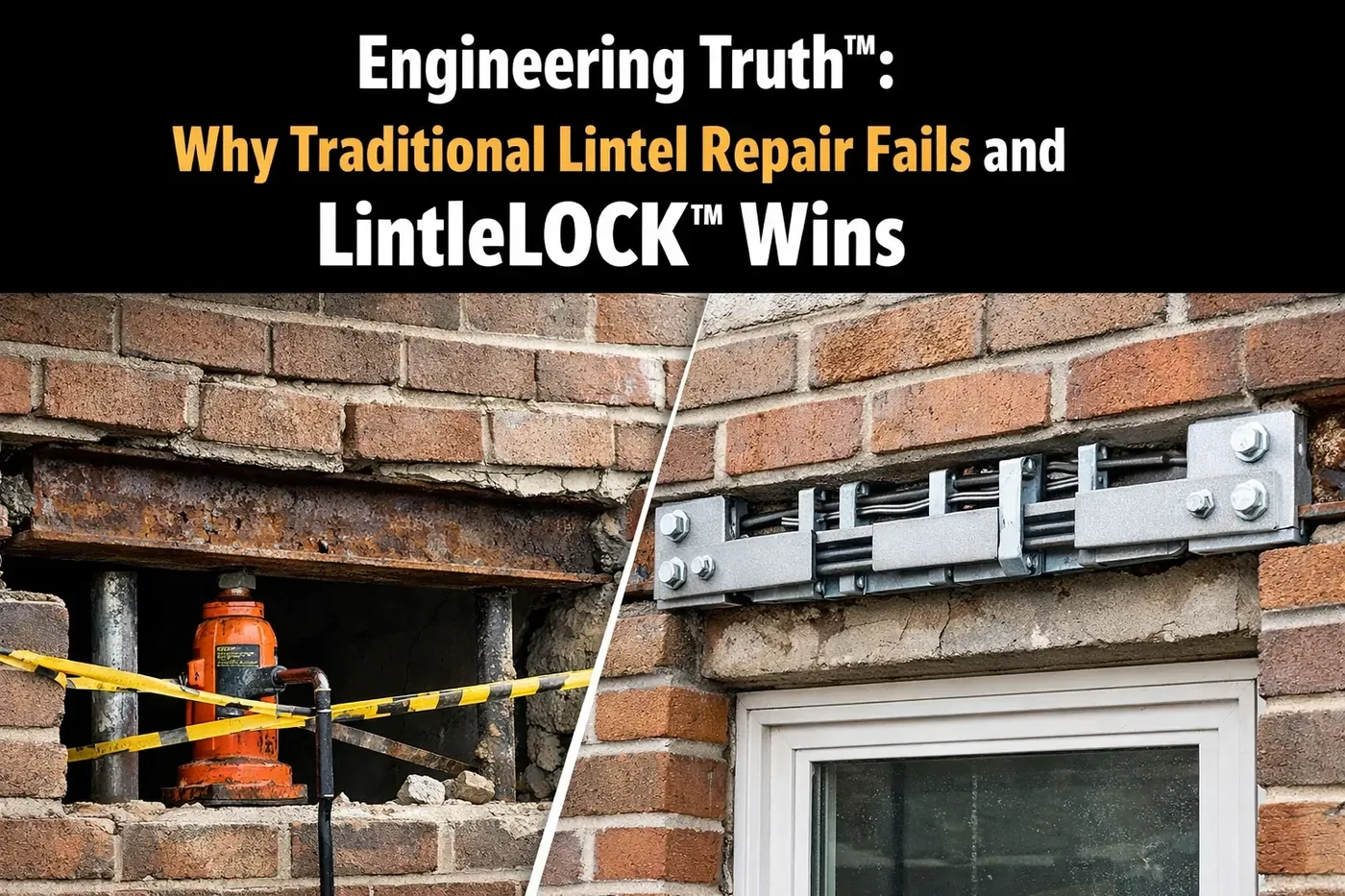
In the Dallas market, sagging lintels over garage doors are one of the most common: and most misrepaired: masonry problems we see. Engineering Truth™: most “traditional” lintel repair is cosmetic first and structural second. That order is backwards, and it’s why the same homes get patched again (and again).
This article lays out, step-by-step, why traditional lintel repair fails and why LintleLOCK™ wins when the problem is a sagging garage lintel.
A lintel is the beam that spans an opening and carries the load of brick above it. Over a typical Dallas garage door opening (often 16 ft wide for a double garage), the lintel is usually steel angle iron. It supports:
The brick veneer above the opening
The self-weight of the masonry (dead load)
Wind load acting on the wall (lateral load)
Expansion/contraction movement over seasons
Garage openings amplify lintel problems because the span is long, the load is continuous, and water management is frequently poor above the door line.
Caution: Don’t assume “it’s just veneer.” Veneer can still crack, shift, and drop when support fails. Veneer failure can create water intrusion, rust acceleration, and ongoing movement that never stops on its own.
Don’t wait for bricks to loosen. Check your garage opening for these lintel repair triggers:
Horizontal cracking in mortar joints directly above the garage door
Diagonal stair-step cracks radiating from the top corners of the opening
A visible sag (brick courses dip at mid-span)
Rust staining bleeding through mortar joints above the lintel
Separated caulk line between brick and trim/soffit
Doors or frames binding because the opening is shifting
If you see two or more of these, you’re not dealing with a “tuckpointing job.” You’re dealing with a lintel support problem that needs real lintel repair.
Traditional lintel repair usually focuses on what you can see: cracked mortar, displaced bricks, and cosmetic alignment. The failure is that the underlying mechanics are not corrected: or not corrected for long.
Here are the most common failure modes.
Grinding out joints and repointing mortar can make cracks disappear temporarily. It does not restore support or stop movement.
Mortar is not a beam.
Mortar repairs cannot carry the same load path as a proper lintel system.
If the lintel is sagging, the wall is still trying to move.
Tip: If someone proposes lintel repair but never addresses how the load is transferred across the opening, you’re buying a reset button: not a solution.
A common “repair” is removing cracked bricks and reinstalling new ones, sometimes with a partial lintel swap. If the root cause is still present (rusted steel, poor bearing, rotation, inadequate anchorage), the new bricks become the new crack location.
Brick is strong in compression but weak in tension. When a lintel rotates or drops, tension shows up in places brick doesn’t tolerate: so it cracks again.
In Dallas, water entry above garage doors is frequent: missing or failed flashing, poor weep function, and sealant breaks are typical. Once moisture reaches steel, rust expands.
Engineering Truth™: Rust expansion can increase steel volume by multiple times, creating outward pressure that:
Pops mortar joints
Spalls brick faces
Forces the brick veneer to “bulge”
Accelerates cracking even if the lintel hasn’t visibly dropped yet
Traditional lintel repair often cleans and paints what’s accessible, but it doesn’t reliably stop the system from moving if water management and stabilization aren’t solved together.
Replacing the steel angle can be necessary in some cases: but it’s frequently done without correcting the reasons it failed:
Inadequate end bearing length
Improper support conditions at jambs
Poor attachment to the wall system
No reliable strategy to prevent future rotation/sag under load
Even a new lintel can fail early if it’s installed with the same geometry, same exposure to water, and same lack of stabilization.
Some contractors “straighten” brick courses while the system is still active. That’s like aligning a door on a settling frame without fixing the hinges.
A proper lintel repair must stop the movement first, then restore the masonry.
LintleLOCK™ is designed for the reality we see daily: sagging lintels over garage doors where the brick veneer is already cracked and shifting.
LintleLOCK™ wins because it prioritizes:
Stabilization
Load-path correction
Repeatable installation
Brick restoration after structural control
In plain terms: you stop the problem before you rebuild the symptom.
![[Image] Exposed brick wall above garage door with LintleLOCK™ system](/images/blog/S2rQMxufvWH.jpg)
Here’s the practical sequence your lintel repair should follow on a sagging garage lintel.
A real lintel repair starts with assessment:
Identify crack patterns (mid-span vs corner-driven)
Look for rust and water routes
Confirm whether the lintel has rotated or dropped
Check brick coursing for deflection over the span
Tip: Measure the sag. Even 1/4" to 3/8" of deflection over a long garage span can telegraph visible cracking in veneer.
LintleLOCK™ focuses on controlling the lintel behavior so the masonry can be rebuilt on a stable base.
This is the key separator between traditional lintel repair and LintleLOCK™ lintel repair: you’re not hoping the wall “holds.” You’re engineering it to hold.
Once the system is stabilized, repair becomes predictable:
Remove damaged bricks cleanly (save what can be reused when possible)
Rebuild in proper bond and alignment
Match mortar color and joint profile so the repair disappears
![[Image] Brick Wall Crack and Lintel Repair](/images/blog/0tlbNwjy0lD.jpg)
Lintel repair that ignores moisture is incomplete. Build your fix so water can exit:
Confirm functional weeps (where applicable)
Repair sealant transitions correctly
Don’t trap water behind fresh mortar
Ensure the repaired area doesn’t become a “water shelf”
Caution: Don’t accept lintel repair that seals everything tight without an exit path. Trapped water is how rust gets a second chance.
Use this list to evaluate any contractor proposing lintel repair on a sagging garage lintel:
Don’t accept a quote that only includes tuckpointing and brick replacement
Don’t allow repairs that ignore rust staining and water entry points
Don’t accept “we’ll caulk it and it’ll be fine” as a strategy
Don’t rebuild brick on an actively moving lintel
Don’t assume a new angle iron automatically fixes the load path
Don’t overlook the garage opening just because the rest of the wall looks fine
If you want the repair to hold, demand a method that stabilizes the lintel system first. That’s what LintleLOCK™ is built to do.
Dallas-Fort Worth homes see:
Big temperature swings (expansion/contraction cycles)
Wind-driven rain events
Soil movement that can subtly change how openings behave over time
High volume production building details where flashing/weep execution varies widely
A sagging lintel over a garage door doesn’t just “age.” It progresses. Once the steel starts moving and rusting, the cycle tends to accelerate.
![[Image] Visible damage to a brick wall above a garage door](/images/blog/t6n0Pw5ojEl.jpg)
When you call us for lintel repair in Dallas, expect direct answers and a repair plan that matches the failure mode.
You’ll get:
A site-specific assessment of your sagging garage lintel
A clear explanation of why the cracking is happening
A lintel repair strategy built around LintleLOCK™ where appropriate
Brick and mortar matching so the finished work blends (not screams “patch”)
For related service details, see:
Use these timing rules:
Schedule now if bricks are loose, cracks are widening, or rust stains are present.
Schedule soon if the wall shows a visible dip over the garage opening.
Don’t wait if you’ve already patched it once and the cracks returned: this is a classic sign traditional lintel repair failed.
If you have lintel repair issues, you need LintleLOCK™: especially when the problem is a sagging lintel over a garage door.
Learn more and request service: http://lintlerepair.com
Prefer to start from our main site? https://www.championbrickrepair.com
After we help you, leave an honest review here: https://g.page/r/CWX03ZFdqAk6EBE/review
“Engineering Truth™: Brick cracks are rarely the problem. They’re the message. Fix the lintel behavior and the masonry repair becomes permanent.” : Brick Repair EXPERT, Owner
Champion Brick Repair is a division of Whitestone Construction, Hamilton, Texas, and is not affiliated with any other companies using similar names.
Cracks are ugly — let Champion Brick Repair fix them right, with mortar matched to your home and a lifetime warranty.