March 19, 2026 · By Abraham Wix-Expert
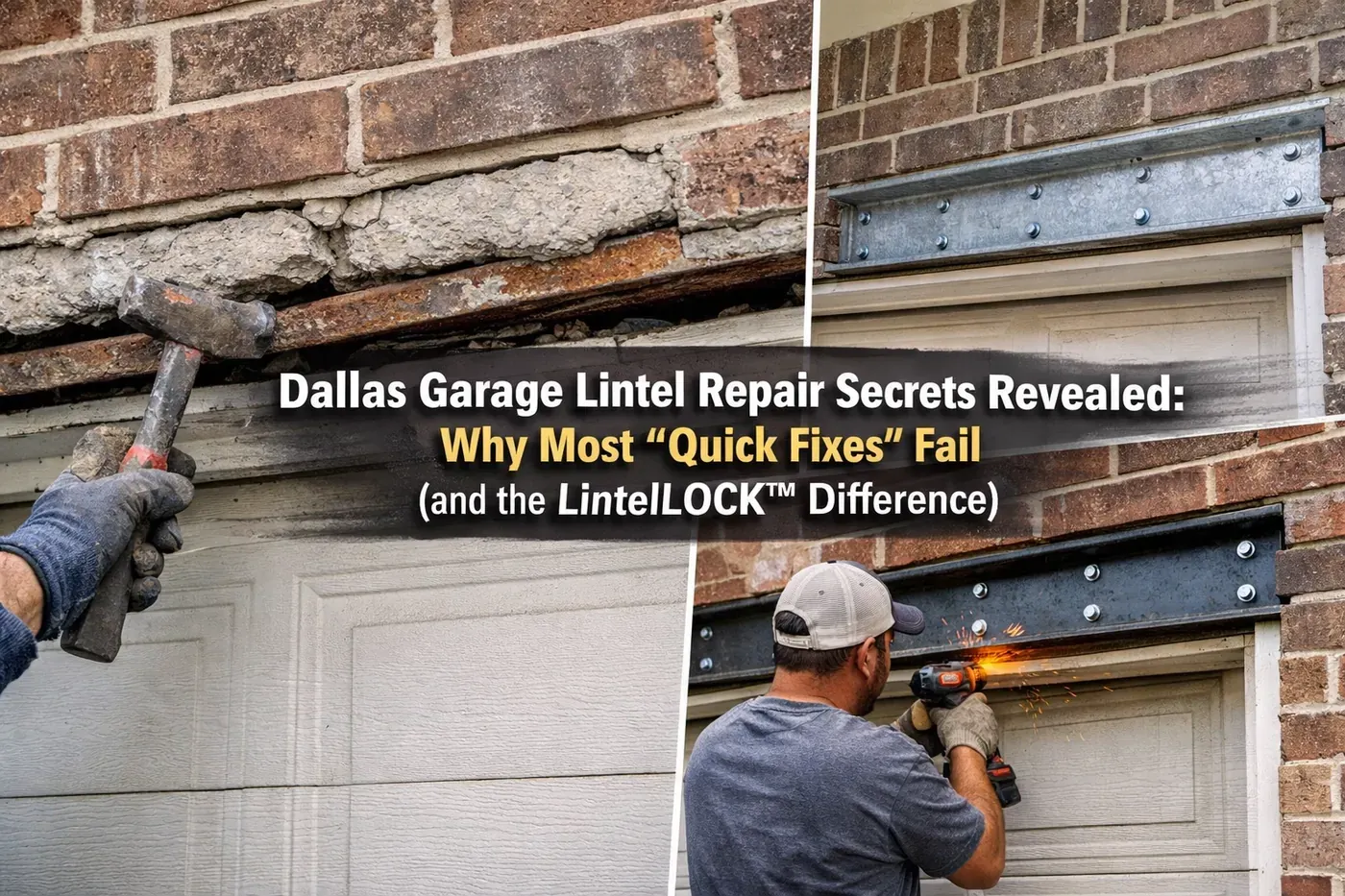
Most homeowners (and plenty of contractors) treat garage-door cracking like a basic masonry issue: grind the joints, add mortar, swap a few bricks, paint the steel, and move on.
Be aware: a sagging garage opening is usually not a mortar problem. It’s a steel lintel problem: and more specifically, a Rotational Lintel Failure problem.
That distinction is the difference between:
a repair that looks good for a few months, and
a repair that stays straight for years.
This post breaks down why most quick fixes fail, what to look for on your home in Dallas, and how the LintleLOCK™ approach addresses the actual failure mechanism (rotation/torsion), not just the cosmetic symptoms.
A lintel is the steel angle (typically angle iron) that spans across the top of your garage door opening and carries the load of brick above it.
Garages are different than small openings:
The span is wider (commonly 16'–18' for two-car garages).
The brick load is heavier.
Water exposure is worse (roof runoff, gutters, splashback).
The steel is often partially embedded in mortar that holds moisture.
So when a garage lintel starts failing, it rarely fails “quietly.”
Here’s the part most “quick fixes” ignore.
A failing garage lintel often doesn’t just drop vertically. It rotates:
The outer edge rolls downward (rotational sagging).
The steel angle twists along its length (torsional twisting).
Brick above responds by cracking, stepping, bulging, and separating.
Look for any of these:
Stair-step cracks above the garage corners
Horizontal cracking following the bed joints above the opening
Bulging brick or a “wave” above the door
Rust staining bleeding through mortar joints
A visible gap between the lintel and brick in spots
Bricks that look like they’re sliding or rotating near the ends of the span
The steel lintel corrodes.
Corrosion expands (rust occupies more volume than steel).
Expansion + load causes rotation/torsion.
Brick is forced out of plane and cracks to relieve stress.
Caution: If you only replace mortar or swap a few bricks without controlling rotation and torsional twist, you’re rebuilding on top of a moving failure.
Quick fixes usually treat symptoms, not mechanics. Below are the common ones: and why they typically come back.
Repointing is great for weatherproofing and maintenance, but it’s not a structural reset for a rotating lintel.
If steel is still twisting, it will re-crack your new joints.
Fresh mortar can actually trap moisture against steel if details aren’t corrected.
Don’t confuse a clean joint with a corrected lintel.
Brick replacement is cosmetic unless you also fix the lintel behavior underneath.
If the lintel keeps rotating, it will:
crack the replacement bricks,
open new joints adjacent to them, and
telegraph the same deformation pattern in the next freeze/heat cycle.
Paint can hide rust for a little while. Caulk can hide gaps. Neither changes steel geometry under load.
Tip: Paint is a finish. Structure comes first.
A heavier angle can help if installed correctly and the load path is re-established, and the rotation mechanism is addressed.
But in the real world, a “bigger angle” often becomes a band-aid because:
the steel still corrodes if water management isn’t fixed,
end bearing is inconsistent,
the new steel isn’t locked to prevent torsional twist,
brick above is rebuilt without correcting the rotation that caused the bulge.
Rigidly packing mortar at lintel ends is a common mistake.
Steel expands and moves with temperature and corrosion. If you lock the ends with rigid mortar, you create stress points that can:
crack brick at corners,
open vertical head joints,
cause recurring separation at the returns.
Caution: Lintel-end detailing needs to accommodate movement, not fight it.
In Dallas–Fort Worth, you’ll see garage lintels fail faster when water is allowed to live where steel meets mortar.
Common contributors:
missing or undersized gutters,
downspouts dumping near the garage opening,
roof valleys directing runoff to the garage face,
failed flashing, especially at brick-to-soffit transitions,
sprinkler overspray and constant wetting at the wall base.
Water + steel + oxygen = corrosion. Corrosion + load = rotation/torsion. Rotation/torsion + brittle masonry = cracking and bulging.
Use this quick evaluation before you pay for cosmetic repair:
If you hit 2–3 of these, treat it like a structural lintel issue, not just brick crack repair.
LintleLOCK™ (by LintelRepair.com) is positioned around one central idea: Rotational Lintel Failure is the core problem, so the solution must reverse rotational sagging and prevent torsional twisting from returning.
This is why “angle iron + mortar + hope” fails so often: it doesn’t reliably stop the rotational mechanism.
Per the concepts presented in the LintleLOCK™ Engineering Manual and White Paper, the objective is to:
re-establish correct alignment at the lintel line,
counteract rotational sagging (not just hide the crack),
control torsional twisting along the span,
lock the assembly so the problem doesn’t creep back.
The slogan says it plainly: "We don't just patch; we lock."
A permanent, engineered garage lintel repair should include:
a plan to address rotation/torsion (not just brick finish work),
load management across the opening,
corrosion mitigation and detailing to reduce future moisture exposure,
masonry restoration with proper bonding and a real brick/mortar match.
LintleLOCK™ is described as the ONLY permanent, patented system for sagging lintels, and it comes with a lifetime warranty when installed per program requirements.
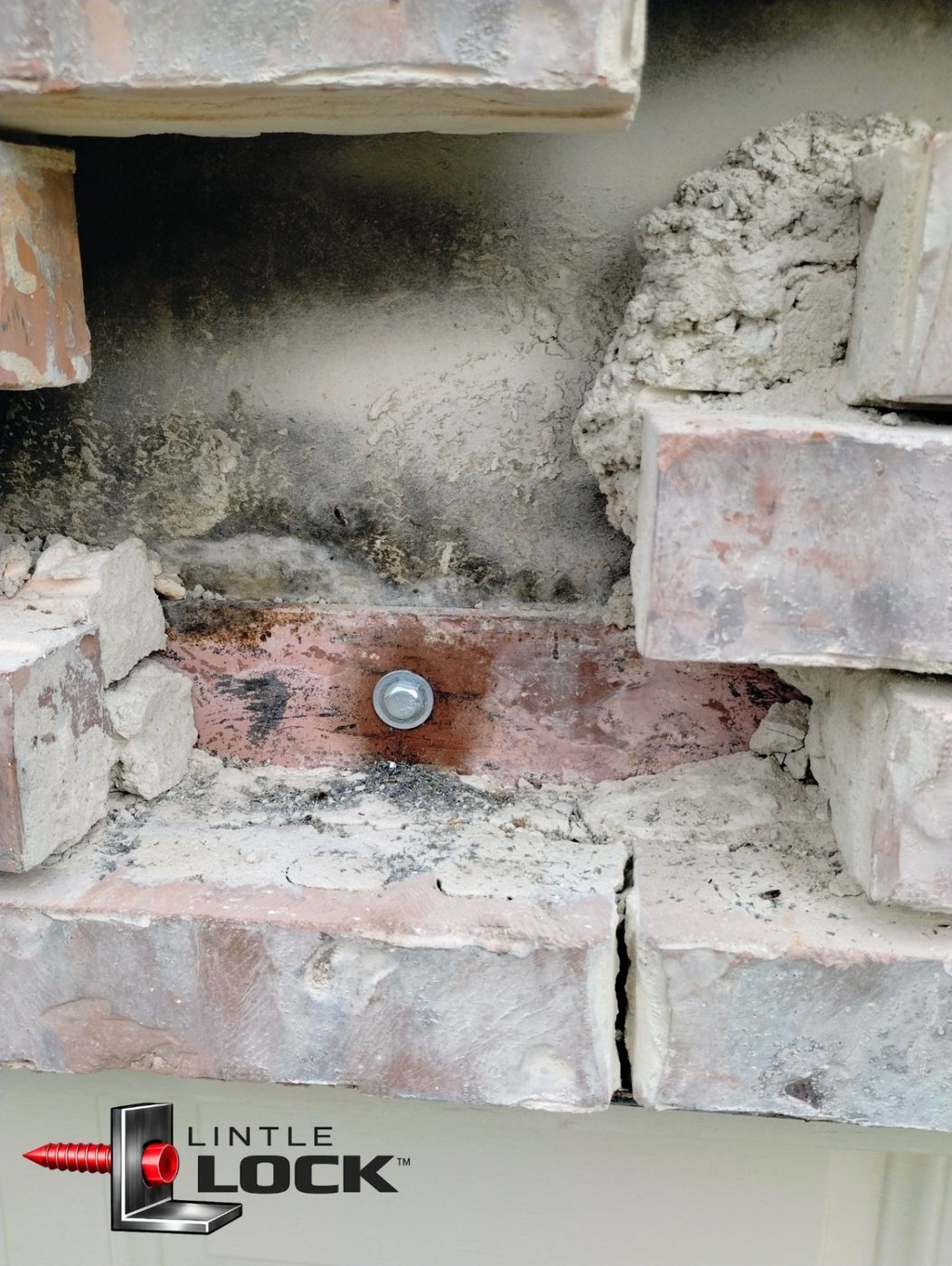
Every house is a little different, but a robust process generally follows the same logic:
People search “garage lintel repair cost” because pricing is all over the map. That’s normal: because the scope is all over the map.
Expect cost to be influenced by:
span width (single vs. double garage),
degree of rotational sagging and torsional twisting,
brick removal and rebuild quantity,
steel condition (surface rust vs. severe corrosion),
access constraints (two-story elevations, tight driveways, steep grades),
brick matching requirements (especially on older homes with discontinued brick).
Industry ranges often land roughly in the $800–$2,000+ bracket for many common cases, but severe failures can exceed that when brick rebuild becomes extensive.
Tip: Don’t compare bids unless the scope is apples-to-apples. One proposal may be “cosmetic reset,” another may be “mechanical correction + lock + rebuild.”
Use this as your red-flag list when reviewing any proposal:
Don’t accept “repoint only” when there’s visible bowing/bulging.
Don’t allow brick to be rebuilt without addressing the underlying steel rotation.
Don’t pack lintel ends tight with rigid mortar without movement detailing.
Don’t ignore water management (gutters/downspouts/valleys).
Don’t accept vague language like “should hold” on a sagging opening.
Don’t assume a thicker angle automatically stops torsional twist.
If your garage opening shows rotational sagging, stair-step cracking, or bulging brick, use the LintleLOCK™ online form for a quick and easy free online estimate:
Estimate link:https://champion-brick-repair.sintra.site/get-estimate
LintelRepair.com hotline:(817) 523-1540
If your issue is standard cracking away from the garage opening, chimney mortar washout, mailbox damage, arch separation, or general brick repair Dallas / masonry repair Dallas TX, keep your scope with Champion Brick Repair & Whitestone Construction.
Useful reading for common crack types and repairs:
Leave a review if we’ve helped you (it matters more than you think):
Google Review link:https://g.page/r/CWX03ZFdqAk6EBE/review
Call Champion Brick Repair & Whitestone Construction at (817) 523-1540 for general masonry service scheduling.
Champion Brick Repair is a division of Whitestone Construction, Hamilton, Texas, and is not affiliated with any other companies using similar names.
Champion Brick Repair & Whitestone Construction are BBB Accredited Businesses : Click for review: BBB profile
Cracks are ugly — let Champion Brick Repair fix them right, with mortar matched to your home and a lifetime warranty.