March 27, 2026 · By Abraham Wix-Expert
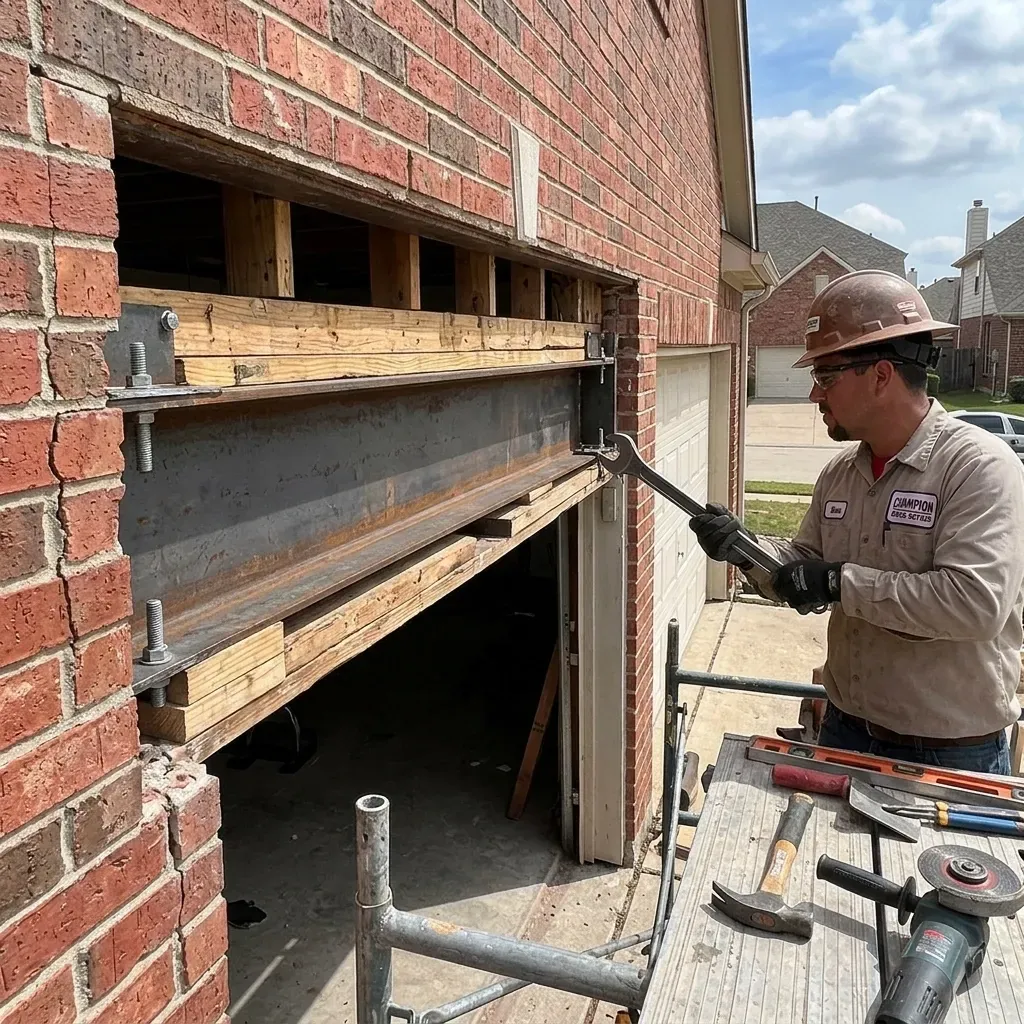
For property managers and structural engineers in the Dallas-Fort Worth metroplex, a sagging garage lintel is a common sight. However, viewing this purely as a vertical deflection issue is a fundamental misunderstanding of the physics at play. What looks like a simple "sag" is often the result of complex torsional forces: specifically, Rotational Lintel Failure.
In the world of masonry repair, we often encounter "solutions" that address the symptom rather than the cause. To truly protect the structural integrity of a multi-family complex or a high-end residential property, one must look beyond the sag and understand the Engineering Truth™ of torsional twisting.
When a garage header begins to fail, the brickwork above it takes on a curved appearance, often referred to as a "smiling" garage. While the name sounds benign, the mechanics are anything but.
Standard construction in DFW typically utilizes a steel angle iron (lintel) to support the weight of the brick veneer across the garage opening. Under ideal conditions, this steel should transfer the load to the vertical jambs. However, the load applied by the brick is rarely perfectly centered over the vertical leg of the angle iron. This creates an eccentric load.
In engineering terms, when a load is offset from the center of gravity of a structural member, it creates a twisting force known as torsion.
Eccentricity: The brick sits on the horizontal leg of the angle iron. Because the center of the brick's mass is offset from the vertical support of the lintel, it creates a moment arm.
Rotational Force: This moment arm generates torsional stress. The angle iron doesn't just want to bend downward; it wants to rotate outward.
Lateral Displacement: As the lintel rotates, the bottom of the brickwork is pushed outward, while the vertical deflection pulls the center down. This dual-action movement is the technical reality of torsional twisting.
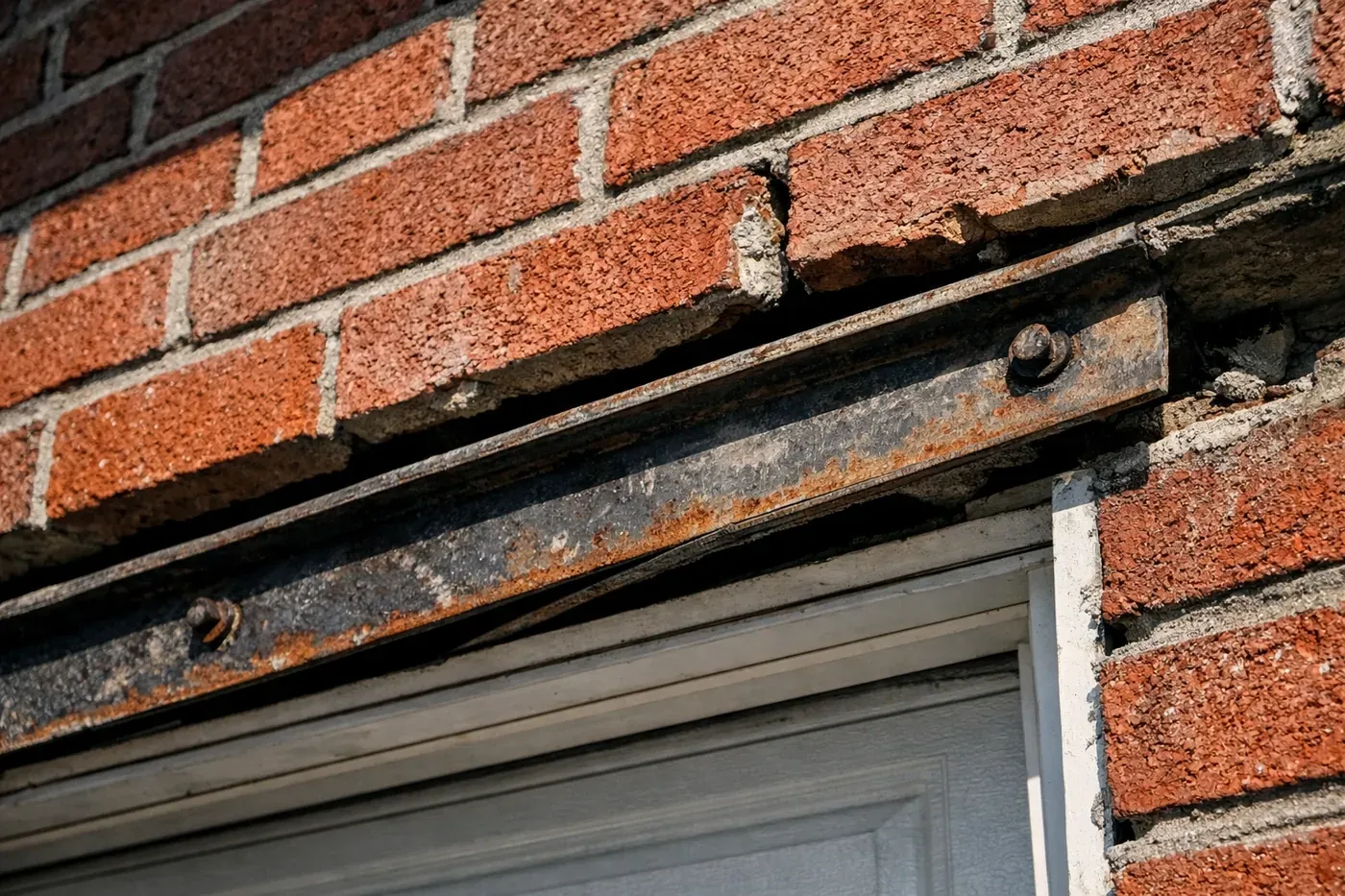
]Technical diagram illustrating the eccentric loading and subsequent torsional rotation of a standard steel lintel under masonry load.
Many contractors in North Texas attempt to solve a sagging header by simply "propping it up" or replacing the existing angle iron with a slightly thicker piece of steel. From an engineering perspective, this is a band-aid, not a cure.
Increasing the thickness of the angle iron increases its resistance to vertical deflection (stiffness), but it does very little to address the torsional instability. An L-shaped angle iron is inherently weak in torsion. Without a mechanism to lock the steel against rotation, the same physics that caused the first failure will eventually cause the second.
Some attempt interior bracing (wood reinforcement, steel plates, or “supporting the header from behind”) and call it a fix. It isn’t.
The brick veneer is an exterior dead load that must be carried at the steel lintel.
Reinforcing the interior framing does not stop the angle iron from rotating under eccentric masonry load.
If the lintel still rotates, your brick still cracks—no matter what you do behind the wall.
Caution: Don’t accept any “fix” that doesn’t explicitly correct torsional twisting (rotation) at the lintel. If rotation remains, the failure mechanism remains.
In the Dallas-Fort Worth area, several environmental factors exacerbate torsional twisting in garage headers:
Expansive Soils: The high clay content in our soil leads to significant foundation movement. When a foundation shifts, even slightly, it can alter the load distribution on the garage header, increasing eccentric forces.
Thermal Expansion: Brick and steel have different coefficients of thermal expansion. In the extreme Texas heat, the steel lintel expands at a different rate than the surrounding masonry, which can loosen the "grip" of the mortar and allow for easier rotation.
Construction Standards: Many suburban developments built during the DFW boom years used the bare minimum requirements for lintel spans, leaving very little factor of safety for torsional loads.
For technical property managers, identifying this failure early is key to preventing a catastrophic collapse or a massive repair bill. Look for these specific technical indicators:
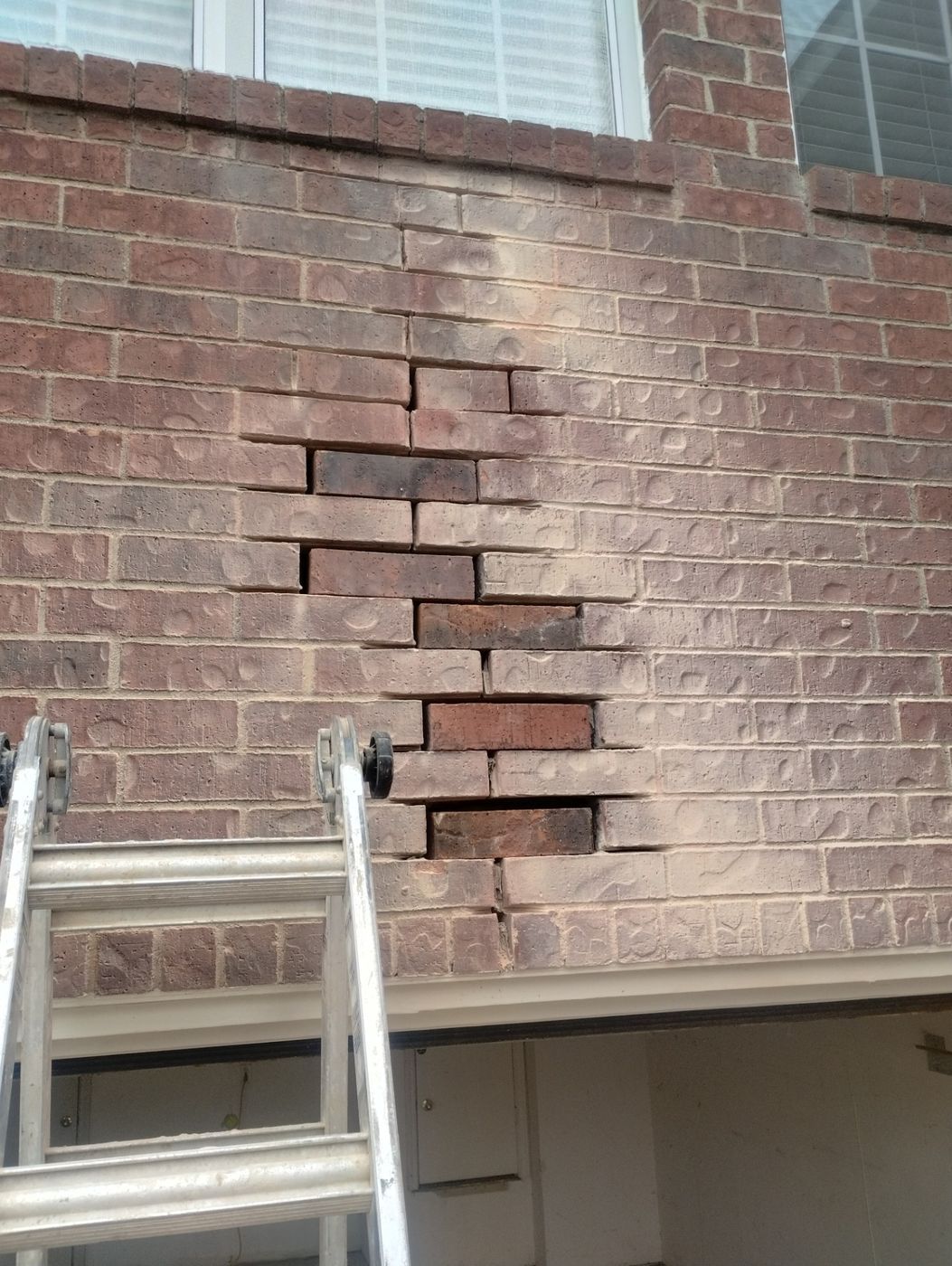
Stair-step Cracking: Look at the corners of the garage opening. Cracks that follow the mortar joints in a diagonal pattern are a sign that the masonry is trying to redistribute the load as the lintel fails.
Horizontal Separation: If the mortar joint directly above the steel lintel is widening, or if you can see a gap between the brick and the steel, rotation is occurring.
Outward Bulge: Stand at the side of the garage and look across the face of the brick. If the center of the span appears to be "pushed out" compared to the edges, you are witnessing torsional displacement.
If the problem is rotation, the solution must be anti-rotational. This is where standard masonry practices fall short and specialized engineering takes over.
LintleLOCK™ is the only patented correction system designed specifically to address Rotational Lintel Failure. It doesn't just support the weight; it reverses the twist.
Unlike traditional repairs that rely on gravity and friction, LintleLOCK™ utilizes a mechanical locking mechanism that ties the lintel into the structural framing of the building in a way that resists torsional forces.
Reversal of Rotation: The system is designed to apply a counter-moment, pulling the sagging lintel back into its original horizontal plane and rotating the steel back toward the structure.
Permanent Locking: Once the lintel is repositioned, the LintleLOCK™ system "locks" it in place. This prevents the eccentric load of the brick from ever initiating the torsional twist again.
Minimal Intrusion: For property managers, one of the biggest benefits is that LintleLOCK™ often eliminates the need for a full teardown of the masonry above the garage.
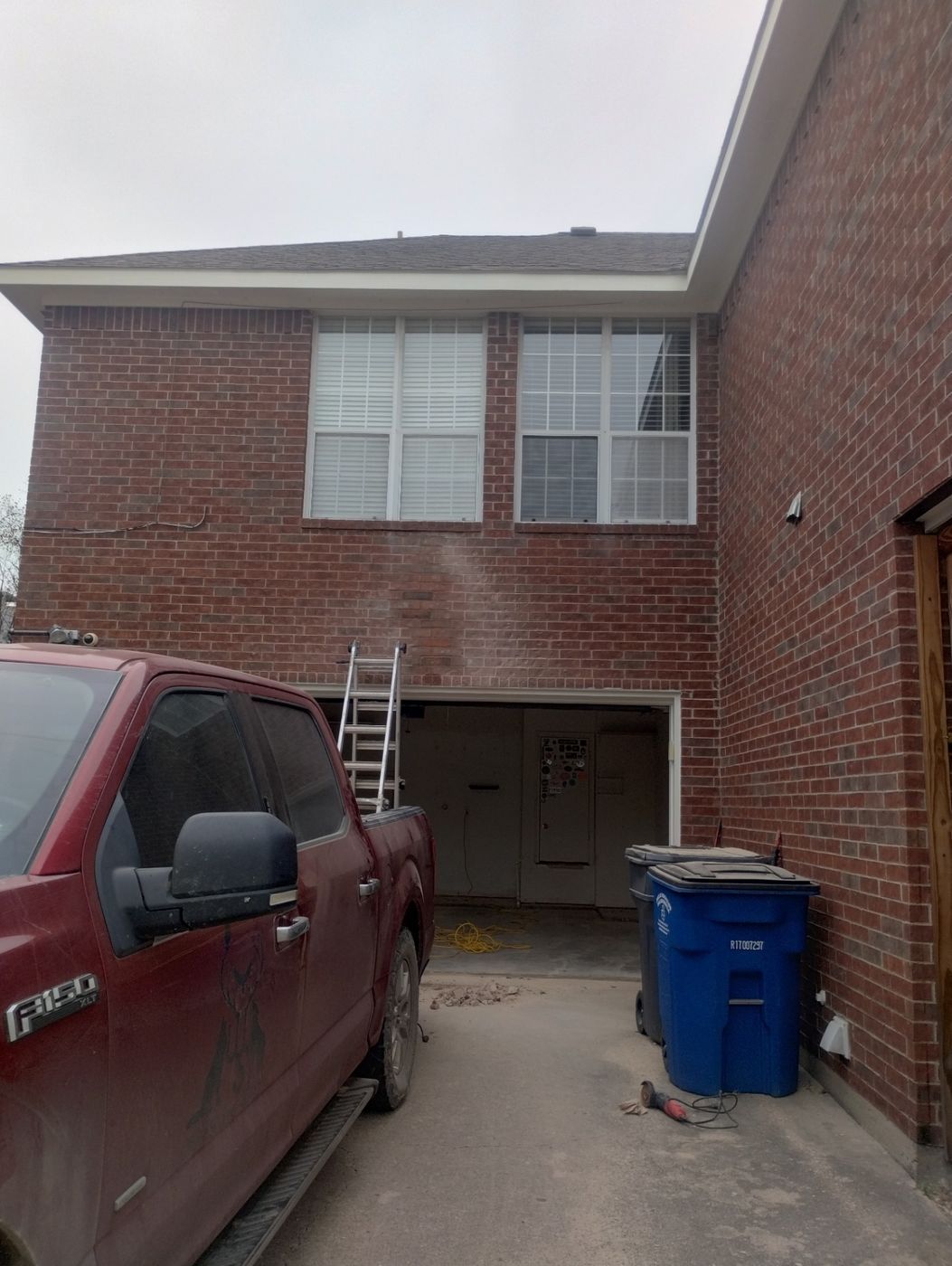
The industry standard slogan for LintelRepair.com is: "We don't just patch; we lock."
This isn't just marketing: it's a structural philosophy. A patch (tuckpointing, replacing a few bricks, or adding a support post) assumes the structure is static. But a garage header is a dynamic environment subject to vibrations from the garage door motor, thermal changes, and soil movement.
By using the LintleLOCK™ system, you are installing a permanent engineered solution that comes with a lifetime warranty. For an engineer or a property manager looking at a 20-year CAPEX plan, the value of a permanent, warranted fix far outweighs the temporary savings of a "patch" job.
When an inspection report flags a “smiling” garage, stair-step cracking, or separation above the door, buyers get nervous and deals stall. Your job is to reduce uncertainty fast—without minimizing a real structural mechanism.
Use Engineering Truth™ to keep the conversation accurate, calm, and solvable.
Provide a simple script that matches what inspectors see:
The common failure mode is Rotational Lintel Failure: eccentric masonry load creates torsional twisting, not just vertical sag.
Cosmetic mortar work doesn’t change the physics. If the steel still rotates, the brick will keep cracking.
A real correction must reverse the rotation and lock the lintel against re-twisting.
Tip: Have your buyer focus on whether the proposed scope addresses rotation (torsion) at the lintel—not just “new mortar” or “new steel.”
Inspection language can be vague (“movement,” “unsupported veneer,” “structural concerns”). Technical clarity helps you answer the buyer’s core question: Is there a defined correction, or are we guessing?
LintleLOCK™ is built around documented concepts from the LintleLOCK™ Engineering Manual and White Paper: load eccentricity, torsional moment, and anti-rotation restraint.
The deliverable is not a “touch-up.” It’s an engineered correction that targets the mechanism causing the cracks.
Deals die in the waiting. You need speed plus precision:
Get crews out quickly to verify rotational sagging indicators (separation at the lintel line, outward bulge, stair-step cracking, measurable deflection).
Provide a clear scope that maps directly to what the inspector called out, so the buyer and lender aren’t left interpreting guesswork.
For a tough home inspector (or a second opinion), the key question is: What prevents recurrence?
LintleLOCK™ is the ONLY permanent, patented system for sagging lintels designed to reverse rotational sagging and resist future torsional twisting.
It mechanically locks the corrected position instead of relying on friction, patching, or assumptions.
It’s backed by a lifetime warranty, which is exactly the kind of durability signal that calms inspection-driven negotiations.
Caution: If a proposal doesn’t state how it prevents lintel rotation from returning, it’s not an inspection-proof solution—it’s a temporary cosmetic reset.
When assessing a portfolio of properties in DFW, prioritize garage headers based on the degree of rotation.
Level 1 (Cosmetic): Minor hairline cracks, less than 1/8" deflection. Monitor and plan for maintenance.
Level 2 (Structural Warning): Visible "smiling" effect, stair-step cracks exceeding 1/4", horizontal separation at the lintel. Immediate intervention via LintleLOCK™ is recommended.
Level 3 (Failure Imminent): Bricks are loose or falling, lintel has visible torsional twist exceeding 5 degrees, garage door operation is compromised. This is a safety hazard requiring emergency structural support.
For a professional assessment and to understand how LintleLOCK™ can be integrated into your maintenance schedule, contact the specialists at LintelRepair.com.
Don't let a "smiling" garage hide a structural failure. Address the torsional reality before it becomes a liability.
Get a Professional Analysis: For sagging garage lintels and the LintleLOCK™ system, call the dedicated hotline: (817) 523-1540.
Online Estimates: We offer a quick and easy free online estimate to help you budget for structural repairs with precision.
Whether you are managing a single residence or a massive commercial portfolio, understanding the "Engineering Truth™" of your masonry is the first step toward long-term structural health.
Administrative Disclaimer: Champion Brick Repair is a division of Whitestone Construction, Hamilton, Texas, and is not affiliated with any other companies using similar names. Champion Brick Repair & Whitestone Construction are BBB Accredited Businesses. Click for review.
Cracks are ugly — let Champion Brick Repair fix them right, with mortar matched to your home and a lifetime warranty.